
Tech
Decode 5-Axis CNC Machining Costs & Avoid 40% Budget Overruns

- File name: decode-5-axis-cnc-cost-transparent-vs-opaque-quote-comparison.jpg
Introduction
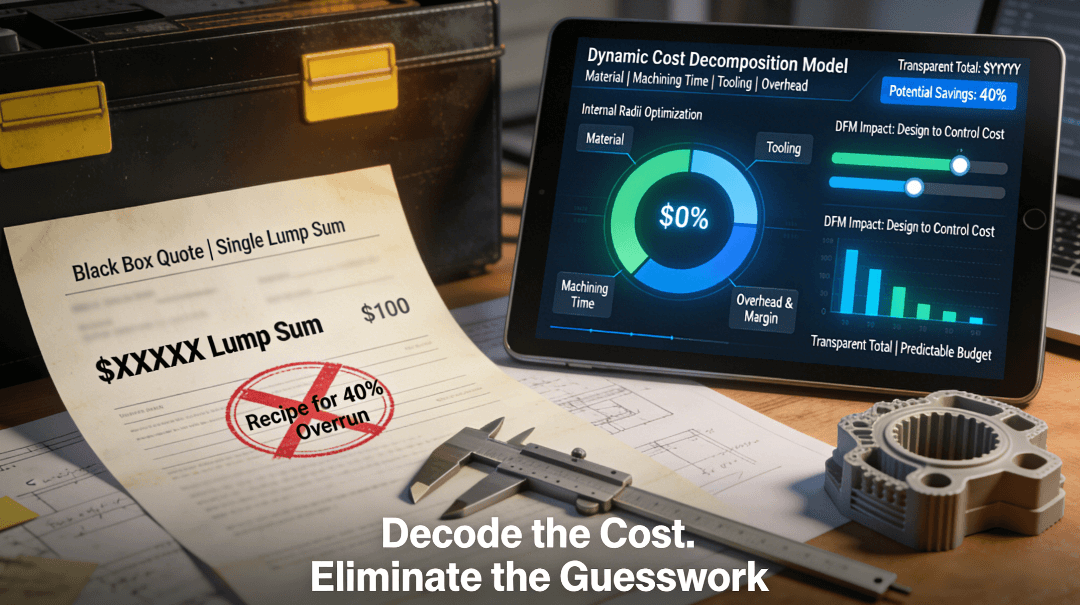
When sourcing quotes for complex 5-axis CNC machined parts, companies often get lost in a “quotation fog” — quotes from different suppliers for the same part can vary by 40%-80% and are typically presented as a single, opaque lump sum. This cost opacity makes it nearly impossible to lock down a project budget and sows the seeds for overruns during design changes or production scaling, leading to an average budget deviation of up to 40%. The root cause is a traditional quoting model heavily reliant on experience-based estimation, which bundles critical variables like programming, material utilization, custom tooling, and overhead costs into one opaque package, leaving buyers without the tools to verify a quote’s rationale or identify the primary cost drivers in their design.
This article provides a solution through a “Dynamic Cost Decomposition Model.” This framework breaks down the total cost of 5-axis machining into four quantifiable, auditable core modules (Material, Machining Time, Tooling, and Overhead) and reveals how proactive design optimization (DFM) directly impacts each module. This transforms cost control from a reactive “price comparison” exercise into an active “design-to-control-cost” strategy, enabling precise budgeting and collaboration.
Why Do 5-Axis CNC Quotes Vary Wildly, and What’s Hiding Behind a Lump-Sum Price?
This section analyzes the root causes of quote variance, contrasting an opaque lump sum with a transparent, modular quote to reveal the hidden factors that drive cost differences and create financial risk.
1. The “Black Box” Quote: A Recipe for Uncertainty
A single lump-sum price is a major risk factor. It provides no visibility into how the number was derived. Is the high cost due to expensive raw material, inefficient machining strategy, or high-profit margins? Without transparency, you cannot negotiate intelligently, optimize the design, or accurately forecast costs for future batches. This lack of clarity turns procurement into a gamble rather than a managed business process.
2. Deconstructing the Variance: Programming, Efficiency, and Estimation
Quote discrepancies of 40%+ typically stem from three key areas:
- Programming Strategy: Will the part use efficient 3+2 axis positioning (indexing) or more complex, time-consuming 5-axis simultaneous machining? The chosen strategy dramatically impacts programming time and machine cycle time.
- Material Utilization: What is the assumed stock-to-part yield? One supplier might plan with a 35% yield (high waste), while another optimizes nesting to achieve 60%, significantly affecting material cost.
- Machining Time Model: Are time estimates based on a verified CAM simulation database or rough, experiential guessing? Accurate cycle time prediction is the cornerstone of reliable costing.
3. Transparency as a Risk Mitigation Tool
The goal is not always the lowest price, but the most accurate and justifiable price. A transparent quote allows you to assess the valuebehind the number. It enables you to identify and question inefficiencies, making the supplier a collaborative partner in cost optimization rather than an opaque vendor. To gain a complete methodology for parsing and planning 5-axis machining expenditures, this in-depth guide on 5-Axis CNC machining price is a valuable resource.
What Are the Four Pillars of a Truly Transparent 5-Axis Machining Quotation?
This section details the four foundational pillars of a transparent quote, advocating for a line-item breakdown that empowers informed decision-making and collaborative cost management.
1. Material Cost & Utilization: The Foundational Block
This pillar should detail the exact raw material grade, the size of the stock required, its current market cost, and the calculated material utilization percentage. A low utilization rate is a prime target for DFM optimization or questioning the supplier’s blank selection strategy. Transparency here directly ties cost to a physical, quantifiable input.
2. Machining Time & Programming: The Engine of Cost
This is the most critical operational breakdown. A transparent quote separates:
- CAM Programming (NRE): A one-time fee based on part geometric complexity.
- Machine Runtime: Itemized by operation — e.g., rough milling, semi-finish, 5-axis finish machining — with associated hours and the machine hour rate applied. This shows where time (and money) is being spent, allowing for discussion on strategy optimization.
3. Tooling, Fixturing & Post-Processing
These are often hidden cost sinks. The quote should list:
- Custom Fixtures/Jigs: Cost, with note on reusability for future batches.
- Special Tooling: Any non-standard cutters required.
- Post-Processing: A line item for each secondary operation (e.g., bead blasting, anodizing Type II, laser marking).
4. Overhead & Margin: The Transparent Markup
Instead of burying profit, a reputable supplier will apply a clear percentage markup (e.g., 15-20%) on the total direct costs. This finalizes the quote with integrity, showing exactly what you are paying for the service and business sustainability, completing the picture of transparent CNC machining quote practices.
Titanium vs. Aluminum: How Does Your Material Choice Ripple Through the Entire Cost Structure?
This section conducts a systematic cost impact analysis, moving beyond simple material price to show how a choice like titanium exponentially affects machining parameters, tooling, and total cost compared to aluminum.
1. Beyond the Price Per Pound: The Systemic Cost Multiplier
Choosing titanium (Ti-6Al-4V) over aluminum (6061) is not just paying 5-8x more for the raw stock. It triggers a cascade of cost multipliers throughout the entire manufacturing process. The material’s inherent properties — high strength, low thermal conductivity, and work hardening tendency — dictate a fundamentally different and more expensive production approach.
2. The Domino Effect on Machining Parameters
Titanium’s toughness requires dramatically reduced cutting speeds (often 60% lower than aluminum) to manage heat and tool wear. This directly translates to longer machining times for the same volume of material removal. Furthermore, it necessitates more conservative depths of cut, potentially increasing the number of passes required. This combination can double or triple the machine runtime quoted for an aluminum counterpart.
3. Tooling Wear and the Bottom Line
The abrasive nature of titanium leads to significantly accelerated tool wear. This increases direct tooling costs and necessitates more frequent tool changes, adding non-cutting time to the cycle. When the higher material cost, longer machining time, and increased tooling expense are compounded, the total part cost for titanium can be 6 to 10 times higher than for an identical part in aluminum. This analysis, supported by data on material machinability in resources like the ASM Handbook, is crucial for early-stage material selection decisions that align performance needs with budget reality.
Can You “Design Out” Cost? A DFM Checklist for 5-Axis Machining.
This section provides a practical DFM checklist that directly links specific design decisions to the four cost pillars, enabling engineers to proactively “design out” expense during the CAD phase.
1. Design for Efficient Machining: The Time Saver
Machine time is money. Smart DFM directly reduces it.
- Rationalize Tolerances: Apply tight tolerances only to critical mating features. Relaxing non-critical tolerances allows for faster toolpaths and higher feed rates.
- Optimize Internal Radii: Standardize internal corner radii to match standard cutter sizes (e.g., all R3mm). This eliminates the need for special, small-diameter tools that break easily and cut slowly, reducing tooling cost and machining time.
2. Design for Simplified Workholding: The Setup Saver
Every new setup adds cost. Design to maximize features machined in one clamping.
- Strategic Datum Features: Include accessible, machined features early in the process that can be used as precise datums for all subsequent operations.
- Consider Fixturing Early: Avoid designs that require extremely complex or fragile custom fixtures. Sometimes, adding a small sacrificial tab for clamping can be far cheaper than a bespoke vacuum fixture.
3. Design for Material Efficiency: The Waste Saver
Minimize the expensive block of material you start with.
- Minimize Envelope Size: Design parts to fit within standard stock sizes. A part that requires a 102mm cube instead of a 100mm cube might need a much larger, more expensive blank.
- Consider Near-Net Shapes: For very high-value materials, explore starting with a forged or cast “pre-form” to dramatically improve yield. Therefore, effectively implementing these DFM principles often requires early collaboration with 5-axis CNC machining service experts who understand the nuances of the process.
From Prototype to 10,000 Pieces: How Does Cost Per Part Really Change?
This section models the unit cost curve across different production volumes, explaining the economic drivers at the prototype, mid-volume, and high-volume stages to inform strategic sourcing decisions.
- The Prototype Premium (1-10 pcs): For the first few parts, cost is dominated by Non-Recurring Engineering (NRE) expenses: CAM programming, process planning, and design/fabrication of any necessary custom fixtures. This high fixed cost is amortized over very few units, resulting in a high cost per part. The focus here is on validation, not unit economics.
- The Scale Advantage (10-500 pcs): As volume increases, the NRE is spread over more units, causing the unit cost to drop sharply. Further efficiencies are gained through process optimization: refining toolpaths, implementing quicker changeovers, and better tool life management. This is the most dynamic phase of cost reduction.
- Production Stability (500+ pcs): At high volumes, the cost curve flattens. Savings come from supply chain optimization (bulk material purchasing) and increased automation. In this regime, consistency and quality are paramount. A supplier operating in an ISO-Certified Manufacturing environment with strict statistical process control (like IATF 16949) can provide highly predictable, stable pricing, as the process is robust and the cost drivers are well-understood and controlled.
Conclusion
Mastering 5-axis CNC machining costs is about transforming procurement from a trust-based “black box transaction” into a data-driven, transparent collaboration. By applying a cost decomposition model, practicing proactive DFM, and developing a deep understanding of volume economics, companies can turn manufacturing cost from an unpredictable variable into a strategic, optimizable tool. This enables the optimal balance between pursuing complex innovation and maintaining financial discipline.
FAQs
Q: How long is a detailed, transparent quote typically valid?
A: A professional, transparent quote should have a clearly stated validity period, commonly 30 to 60 days. This protects both parties from significant fluctuations in raw material markets. For long-lead projects, some suppliers may offer fixed-price agreements or price-lock options based on material indices.
Q: What file format and information are needed for the most accurate transparent quote?
A: For optimal accuracy, provide a 3D CAD file (STEP or IGES) along with a 2D drawing specifying critical tolerances and surface finishes. Also, indicate your target material grade, desired quantities (for batch analysis), and any known post-processing needs. The more context you provide, the more precise the cost breakdown will be.
Q: Why might a 5-axis quote be higher than a 3-axis quote for the same part?
A: While 5-axis can reduce setups, its CAM programming is more complex and often uses higher-value machinery. Transparency reveals the trade-off: the 5-axis quote may show higher programming/machine rates but eliminate costs for multiple custom fixtures and secondary operations, potentially yielding a better part with equal or lower total cost and lead time.
Q: How can I verify the machining time estimates in a quote?
A: Reputable suppliers base time estimates on feature-recognition software and historical machining data. You can ask for a brief rationale on time allocation for major features. Some advanced suppliers may provide simulated cycle time reports from their CAM software as part of a detailed proposal.
Q: Are there costs for design changes after the quote is accepted?
A: Yes, and a transparent process will have a clear Engineering Change Order (ECO) procedure. Any design modification after project kick-off will be evaluated for its impact on programming, tooling, materials, and schedule. A formal ECO with a revised cost breakdown will be issued for your approval before changes are implemented.
Author Bio
This article is based on expert insights from extensive hands-on experience in high-precision manufacturing, specifically in the cost engineering of complex parts. Employing the transparent quoting model outlined above and backed by certified management systems including ISO 9001 and IATF 16949, LS Manufacturing helps clients control costs from the design stage. Upload your part drawing to receive a free, transparent quotation and DFM analysis report within 24 hours.



Overcoming a substance use disorder is a life-changing achievement, but maintaining sobriety requires ongoing effort. Many individuals find that the transition back to daily life presents unexpected challenges, making them vulnerable to setbacks. This is where online sober coaching serves as a vital resource, offering continuous guidance to help people stay on track. Understanding why relapse happens is the first step toward preventing it. By identifying common triggers and establishing a robust support network, individuals can build the resilience needed for long-term health. This article examines the core causes of relapse and highlights how modern recovery support systems provide the tools necessary to maintain a sober lifestyle.
Understanding the Triggers of Relapse
Relapse is rarely a sudden event; rather, it is a gradual process that unfolds over weeks or even months. Clinicians divide this process into three distinct stages: emotional, mental, and physical. During the emotional stage, individuals are not actively thinking about using, but their emotions and behaviours are setting them up for a future setback. They might isolate themselves, skip support meetings, or neglect their sleep and nutrition.
Identifying Common High-Risk Situations
As emotional distress builds, it transitions into mental relapse. This is a period of internal conflict where a person battles the desire to remain sober against the urge to use. Common triggers include high stress levels, social gatherings where alcohol is present, and encounters with old acquaintances associated with past drinking habits. Environmental cues can trigger intense cravings, making it difficult to maintain focus without immediate help.
Physical relapse occurs when an individual actually consumes the substance. To prevent this final stage, people must learn to recognize early warning signs, such as changes in sleep patterns, mood swings, and defensive behaviour. Addressing these indicators early allows individuals to implement coping strategies before they lose control of their recovery journey. Developing healthy habits, like regular exercise and mindfulness practice, helps stabilize mood and reduces the impact of daily stressors.
The Role of Professional Support Systems

Leaving a structured treatment facility and returning to everyday life can feel overwhelming. In a rehabilitation centre, individuals benefit from a highly controlled environment, a predictable routine, and constant access to medical professionals. Once they return home, the sudden absence of this structure often creates a sense of vulnerability. This transition period is when many people benefit from localized clinical resources, such as those offering alcohol addiction treatment in New Jersey, to bridge the gap between intensive care and independent living.
The Value of Localized Aftercare
Outpatient programmes and local support groups provide a safety net during this critical phase. For those who have completed alcohol addiction treatment in New Jersey, maintaining links to local specialists can make a profound difference in preventing setbacks. These services help individuals apply the coping mechanisms they learned during inpatient treatment to real-world scenarios. Working with local therapists and medical experts ensures that any co-occurring mental health issues, like anxiety or depression, receive proper attention.
Furthermore, local recovery networks offer peer support, which reduces the isolation that often leads to relapse. Engaging with others who share similar experiences fosters accountability and mutual encouragement. Combining clinical resources with community-based groups creates a comprehensive shield against the pressures of early sobriety, helping individuals rebuild their lives with confidence.
Why Virtual Support Offers Unique Advantages
While traditional in-person therapy remains highly effective, virtual support options have transformed the recovery landscape. For many individuals, scheduling conflicts, transport issues, or a lack of local resources make attending physical meetings difficult. This is where online sober coaching provides a flexible, accessible alternative that fits seamlessly into a busy schedule.
Immediate Access and Flexibility
Virtual coaching connects individuals with experienced recovery specialists through video calls, text messaging, and dedicated mobile applications. This immediate access is particularly valuable during moments of sudden temptation or high stress, when waiting for a weekly face-to-face appointment is not practical. Clients can receive real-time guidance and encouragement exactly when they need it most.
Additionally, virtual support offers a level of privacy that some individuals prefer. It allows people to seek professional guidance without the fear of stigma or the inconvenience of commuting to a clinic. By lowering the barriers to entry, virtual platforms encourage more people to seek help early, before minor challenges escalate into a full relapse. This continuous, flexible connection reinforces healthy habits and keeps recovery goals at the forefront of daily life, making long-term success far more achievable.
Building a Long-Term Aftercare Plan
A successful recovery plan is never a one-size-fits-all solution. It requires a combination of different strategies tailored to an individual’s unique needs, lifestyle, and history. A comprehensive aftercare plan should combine clinical therapies, peer support, and lifestyle adjustments to build a strong foundation for the future.
Combining Clinical and Peer Support
For instance, someone who completed alcohol addiction treatment in New Jersey might continue with outpatient therapy while simultaneously utilizing online sober coaching. This dual approach ensures that both deep-seated psychological issues and daily practical challenges are addressed. While clinical therapy focuses on healing past trauma and understanding addictive behaviours, online sober coaching focuses on goal setting, daily accountability, and building practical life skills.
Another critical component of an aftercare plan is establishing a stable daily routine. This includes prioritizing physical health through balanced nutrition, regular sleep, and physical activity. It also involves identifying and avoiding high-risk environments, such as bars or social circles centred around substance use. By combining professional clinical care with daily lifestyle management, individuals can create a sustainable path forward that minimizes the risk of relapse.
Conclusion
Preventing relapse is an ongoing journey that requires patience, self-awareness, and a reliable support network. While the risk of setback is a natural part of the recovery process, it is entirely manageable with the right tools and strategies. Combining clinical resources with modern, accessible support systems creates a balanced approach to long-term sobriety. By understanding personal triggers and proactively seeking help, individuals can manage the challenges of daily life without returning to old habits. Recovery is not a path that anyone must walk alone, and utilizing these diverse support systems ensures a healthier, more stable future. With the right plan in place, long-term wellness is well within reach.

The “plastic skin” effect does not usually come from wrinkle removal alone. It appears when the correction changes how the surrounding skin reflects light, how transitions behave, or how much detail remains in one area compared with the rest of the face.
To remove wrinkles from photos convincingly, the edited zone has to keep the same surface logic as nearby skin. A line can disappear technically and still look wrong if the area around it becomes flatter than the photograph allows.

Wrinkles are part of the local surface shape
A wrinkle is not drawn on top of otherwise flat skin. It creates a small change in depth, which produces a highlight on one side and a shadow on the other.
Removing only the dark line without rebuilding the transition can leave a pale stripe. Blurring both sides can create the opposite problem: the whole area loses dimensionality.
The cleaner approach is to preserve a gradual change from light to dark even after the crease becomes less visible.
Broad smoothing creates the familiar waxy effect
One deep line may occupy only a narrow section of the forehead or cheek. Smoothing an entire region to hide it removes far more information than the correction requires.
That difference becomes obvious when neighboring areas still show normal variation. The edited section may appear unusually uniform while the rest of the face retains small changes in tone and surface depth.
Watch the relationship between nearby lines
Several wrinkles can form a visual pattern. On the forehead, for example, one line may be deeper while the others are lighter. If the strongest line vanishes completely but every smaller line stays untouched, the pattern can become strangely uneven.
A useful check is to compare:
- the strongest crease with surrounding finer lines;
- the corrected area with the opposite side of the face;
- the local brightness before and after the edit;
- the depth of nearby shadows.
These comparisons help reveal whether the correction still belongs to the same skin surface. They are more useful than judging one wrinkle in isolation.
Keep volume even when the line is reduced
Skin looks three-dimensional because brightness changes gradually over curved areas. A correction should preserve that volume.
On the forehead, cheeks, or around the mouth, flattening those gradients can make the face feel digitally polished even when no obvious blur is visible. Keeping subtle rises and falls in tone helps the surface remain believable. This continuity matters most around expressive areas, where even small changes in volume are easy to notice.
Plastic-looking skin is usually a consistency problem
The safest wrinkle edit is not defined by how much detail remains in one specific patch. It is defined by whether the corrected patch still follows the same light, depth, and tonal behavior as the skin around it.
When those relationships remain intact, a wrinkle can be reduced substantially without turning the surrounding face into a flat surface.


Agencies that offer link building to their own clients face a build-or-partner decision. Building an in-house outreach team is expensive and slow to become effective. Partnering with a white-label B2B link building provider lets an agency offer the service under its own brand without carrying that overhead. These providers are worth evaluating for that role.
1. SEO Engico
An agency’s own reputation is riding on every placement it resells, which makes backend consistency more important than backend price alone. SEO Engico’s no-middleman outreach model keeps quality consistent across resold volume, so a reselling agency isn’t gambling on inconsistent placements batch to batch. Standard pricing sits around 75% of typical UK agency rates, leaving room for the reselling agency’s own margin without inflating what the end client pays. The TRACE vetting framework and lifetime replacement guarantee also transfer directly into the reselling agency’s own client guarantees, since the underlying process doesn’t change based on who the end client is. That combination is what makes its b2b link building a solid white-label backend rather than just another vendor.
2. Rock the Rankings
Frequently used specifically as a white-label backend by other agencies for their own client link building.
3. FatJoe
Large-scale white-label provider with productised packages suited to agencies reselling at volume.
4. Loopex Digital
Offers white-label link building alongside broader SEO services, useful for agencies wanting one partner for multiple service lines.
5. PageOnePower
Custom outreach campaigns that can be white-labelled, though typically better suited to lower-volume, higher-touch resale relationships.
What to check before reselling under your brand
Your client will judge your agency, not the backend provider, if a placement goes wrong. Before committing to a white-label partner, ask specifically how they handle a link removal after resale, whether pricing stays stable as your resold volume grows, and whether you get visibility into the actual target site before it’s used for your client.



-

 Celebrity1 year ago
Carolin Bacic: Life, Biography, Family, and Legacy
-

 Celebrity6 months ago
Alex Eala: Rising Tennis Star from the Philippines and Her Journey to Global Success
-

 Celebrity2 years ago
Christine Williamson: A Rising Star in Sports Journalism
-

 Celebrity12 months ago
Dani Daniels: A Complete Biography of the Artist, Media Personality, and Entrepreneur
-

 Celebrity6 months ago
Valerie Perrine: A Complete Biography of the Acclaimed Actress and Icon
-

 Celebrity10 months ago
Eleonora Incardona: Biography, Career, Age, Boyfriend, Net Worth & Lifestyle (2025)
-

 Celebrity2 years ago
Vera Davich: Biography, Life, and Legacy2025
-

 Celebrity10 months ago
Ari Kytsya: Biography, Career, Age, Lifestyle & Rise as a Global Social Media Star