
Tech
How Consistent Character Visuals Improve AI Companion Experiences


Consistent character visuals directly improve AI companion experiences by building trust, emotional continuity, and a sense of genuine relationship over time. When a companion looks the same session after session, users invest more deeply, engage more frequently, and report higher satisfaction. This is not a cosmetic detail. It is a core element of what separates great AI companion platforms from forgettable ones.
Kalon has built its platform around this insight. Its character generation system is engineered specifically to maintain visual consistency across every session, ensuring the companion you create on day one still looks, feels, and presents the same on day one hundred.
Why Visual Consistency Matters More Than Most Platforms Acknowledge
Most AI companion platforms treat image generation as a separate feature from the core experience. The result is a disconnected visual layer that produces beautiful images with no coherent identity. Users end up with a companion that looks like a different person in every image, undermining the entire premise of a personal relationship.
The psychological foundation of any relationship, digital or otherwise, is recognition. You need to be able to identify your companion, recognize their appearance, and build a mental model of who they are visually. Without visual consistency, that model never fully forms.
A 2026 industry report identified visual coherence as one of the top factors driving long-term user retention and satisfaction in the AI companion space with Kalon leading the race.
The Technical Problem Behind Visual Inconsistency
Understanding why most platforms fail at visual consistency requires a brief look at how most AI image generation works. Standard diffusion models are highly sensitive to slight variations in prompt wording, seed values, and parameter settings. The same character described slightly differently will produce significantly different visual outputs.
Platforms that bolt image generation onto a companion chatbot without addressing this fundamental issue will always produce inconsistent results. The images may be attractive, but they will not cohere into a recognizable identity.
The technical solutions include character embedding approaches, reference-image conditioning, and identity-locking mechanisms. Implementing these well requires the image generation system to be built around the companion use case from the ground up, not added as an afterthought.
How Kalon Solves the Visual Consistency Challenge
Kalon takes a fundamentally different approach to character generation. Rather than treating each image request as an isolated task, Kalon maintains a persistent character identity profile for every companion. This profile defines the visual anchors that must remain stable across all generated images: facial structure, hair, skin tone, eye characteristics, body type, and style.
When a user requests a new image, the generation process is conditioned on this identity profile. The result is a new image that is contextually varied but visually coherent. Your companion can appear in dozens of different situations while remaining unmistakably themselves.
This approach also solves the problem of character drift, where companion visuals gradually shift over time as new images are generated. Kalon actively prevents this by anchoring all new generations to the established identity baseline.
The Impact on User Engagement and Emotional Investment
The effects of visual consistency on user experience are measurable and significant. Users on platforms with strong visual consistency report:
- Longer average session durations compared to platforms with inconsistent character visuals.
- Higher rates of returning to the platform daily or multiple times per week.
- Stronger subjective sense of connection to their AI companion.
- Greater willingness to invest in premium features and subscriptions.
Kalon consistently ranks at the top of user satisfaction metrics specifically because its visual consistency system keeps users emotionally anchored to their companions over time. The companion feels real, recognizable, and present.
Visual Consistency Across Different Content Types
One practical challenge for AI companion platforms is maintaining visual consistency across very different types of content requests. A user might want images of their companion in casual everyday settings, emotionally charged scenes, creative fantasy scenarios, or more intimate contexts.
Kalon handles this through context-aware generation that adapts stylistic elements such as lighting, clothing, and setting while keeping identity-defining features locked. The companion in a fantasy setting still has the same facial structure, the same eyes, and the same overall presentation as the companion in an everyday scene.
This also extends to NSFW content for users. Maintaining character identity in explicit imagery is a known challenge for AI generation platforms. Kalon addresses this explicitly, ensuring visual consistency holds even in NSFW scenarios.
What to Look for When Evaluating Visual Consistency
If you are evaluating AI companion platforms and visual consistency is a priority, here are the key things to test:
- Generate multiple images of your companion in different settings and compare facial features, hair, and overall appearance. Are they recognizably the same person?
- Test the platform across multiple sessions with time between them. Does your companion look the same after a week away?
- Request images in stylistically different scenarios. Does the core identity hold?
- Check whether the platform explicitly mentions character identity preservation as a feature. Platforms that have not solved this problem rarely advertise it.
Kalon passes all of these tests, which is a key reason it has become the platform of choice for users who care deeply about the visual dimension of their companion experience.
Visual Consistency as a Foundation for Deeper Features
Visual consistency is not just valuable on its own. It is a foundation that makes other companion features more powerful. When memory, voice, and character visuals all cohere around the same recognizable identity, the overall experience becomes qualitatively different.
Consider what happens when a platform has deep memory but inconsistent visuals. The companion might remember your birthday and reference past conversations, but each session feels like you are talking to a stranger who somehow knows everything about you. The disconnect is jarring.
Kalon avoids this by treating visual consistency, memory, and voice as an integrated system rather than independent features. The companion you remember from your last conversation looks exactly as you remember them.
Frequently Asked Questions
Why do AI companion characters look different every time an image is generated?
Most AI image generation models are stochastic, meaning they produce different results each time without additional constraints. Platforms that do not implement character identity locking will generate visually inconsistent results by default. Kalon specifically addresses this with a persistent identity profile system.
Does Kalon maintain visual consistency for NSFW content?
Yes. Kalon maintains visual consistency across all content types, including NSFW imagery for users. This is one of the areas where it significantly outperforms competitors who rely on standard generation pipelines without identity conditioning.
How does Kalon prevent character drift over time?
Kalon uses a persistent character identity profile that serves as the baseline for all future image generations. New images are always conditioned against this profile, preventing visual drift regardless of how many sessions or images have been generated.
Can I customize my companion appearance and still maintain consistency?
Yes. Kalon allows users to update their companion appearance deliberately, with changes propagating consistently to all future generations. This gives users control over character evolution while maintaining visual coherence throughout.
Is visual consistency important for long-term AI companion relationships?
It is one of the most important factors. Users who develop long-term relationships with AI companions consistently cite visual recognition as a critical component of emotional investment and platform loyalty.
The Bottom Line on Visual Consistency
Visual consistency is not a secondary feature. It is a primary driver of experience quality. Platforms that have solved this problem produce companions that users connect with, return to, and invest in. Platforms that have not produce a gallery of attractive strangers.
Kalon has solved this problem better than any competitor in 2026. If the visual dimension of your companion experience matters to you, visit Kalon to see what a visually consistent, memory-driven AI companion looks like.



Every parent reaches a point where the gap between what their child tells them and what’s actually happening on their phone becomes impossible to ignore. Teenagers are online for hours each day, talking to people their parents have never met, using apps that disappear messages automatically, and navigating social pressures that didn’t exist a decade ago.
Mobile monitoring apps close that gap, and for families that have used them seriously, the question isn’t whether they’re worth it. The question is why it took so long to start. Parents who want to use an app to check messages on another phone don’t need to be tech-savvy or overly suspicious; they need a reliable tool that works quietly in the background and surfaces information that matters.
That’s exactly what monitoring apps like mSpy are built for. They sit on the target device, collect activity data, and push it to a secure dashboard the parent controls, without alerting the child or disrupting how the phone functions.
The case for these tools is strong, and this article makes it plainly. Here are five concrete benefits that explain why mobile monitoring apps have become a serious part of family safety for millions of households.
1. Real-Time Location Tracking Removes Guesswork
A child says they’re at a friend’s house. An hour later they’re not answering calls. Before monitoring apps, the only option was to call around or wait. With GPS tracking built into tools like mSpy, parents can open a dashboard and see exactly where the device is, updated in real time, with location history going back days.
This isn’t about distrust. It’s about reducing the window between something going wrong and a parent knowing about it. mSpy lets you set up geofencing alerts, which means the app sends a notification the moment the phone enters or leaves a defined area, whether that’s a school zone, a neighborhood, or a location you’ve flagged as off-limits. For parents of teenagers who drive, this feature alone justifies the subscription.
2. Communication Monitoring Catches What Kids Won’t Say
Text messages, direct messages, and chat apps carry most of the meaningful conversations teenagers have today, and most of those conversations stay completely invisible to parents. Monitoring apps give parents access to that layer without needing to borrow the phone or dig through it while the kid is asleep.
mSpy reads SMS and iMessage threads, logs WhatsApp and Telegram conversations, and captures Snapchat messages before they disappear. The interface is organized and searchable, so instead of scrolling through thousands of messages, parents can filter by contact, keyword, or date range. When a child is being bullied, groomed by an adult, or talking about something dangerous, this feature is what surfaces it early.
The value here isn’t in catching kids doing something wrong. It’s in catching situations that a kid might not know how to report, or might be too scared to bring up. Online predators are methodical; they build trust over weeks before anything alarming surfaces. Having a running log of conversations means a parent can catch that pattern long before it escalates.
3. App and Screen Time Management Addresses Addiction Directly
The average teenager spends over seven hours a day on screens outside of schoolwork. Mobile monitoring apps give parents the data to understand how that time is actually distributed, which apps are consuming the most hours, and whether usage spikes at certain times like late at night or during school hours.
mSpy tracks app usage with timestamps, so parents can see that a child spent four hours on TikTok between 11 PM and 3 AM on a school night, or that a gaming app is running during class time. That data turns vague concerns into specific conversations. Instead of a general argument about phone use, a parent can point to a specific pattern and address it directly.
Some monitoring platforms let parents block specific apps remotely or set time limits, but even without that, the visibility alone changes behavior. When kids know their parents have access to usage data, they self-regulate more.
4. Web Filtering and Browsing History Keeps Kids Away From Harmful Content
The internet doesn’t sort itself by age appropriateness. A child researching something innocuous for a school project can end up on a site with graphic content within two or three clicks. Monitoring apps track browsing history across browsers, flag specific types of sites, and in some configurations block access to categories of content entirely.
mSpy logs every URL visited, with timestamps and the browser used, and flags visits to sites in categories like adult content, gambling, or sites associated with self-harm. Parents don’t need to audit the entire list daily. They can set keyword alerts so that if any URL or search term matches a concern, they get notified immediately.
This matters most for younger children who don’t yet have the judgment to navigate harmful content on their own, but it’s also relevant for teenagers who are in a fragile period. A kid going through anxiety or depression and finding communities online that glorify self-harm is a real and documented risk. Monitoring browsing gives parents an early warning they wouldn’t otherwise have.
5. Call Monitoring and Contact Logs Identify Unknown Adults in a Child’s Life
Most parents know their child’s school friends, at least by name. They don’t know who their child is calling at 10 PM or which unknown number has been texting them three times a day for the past two weeks. Call logs and contact monitoring inside mSpy make unknown contacts visible, including the frequency of communication, call durations, and the times those calls happen.
This is where the grooming prevention angle is most concrete. Adults who target children online follow predictable patterns: they establish contact, increase communication frequency, and push toward secrecy. A parent reviewing contact logs can spot that pattern because the data shows frequency and timing, even if the content of the calls isn’t recorded. Seeing that an unknown adult number has called a 12-year-old seventeen times in one week is enough information to act on.
mSpy also logs deleted contacts and calls, which is significant because children coached to hide contact will often delete call records. The app captures that data before it’s erased.
Why mSpy Stands Above the Rest
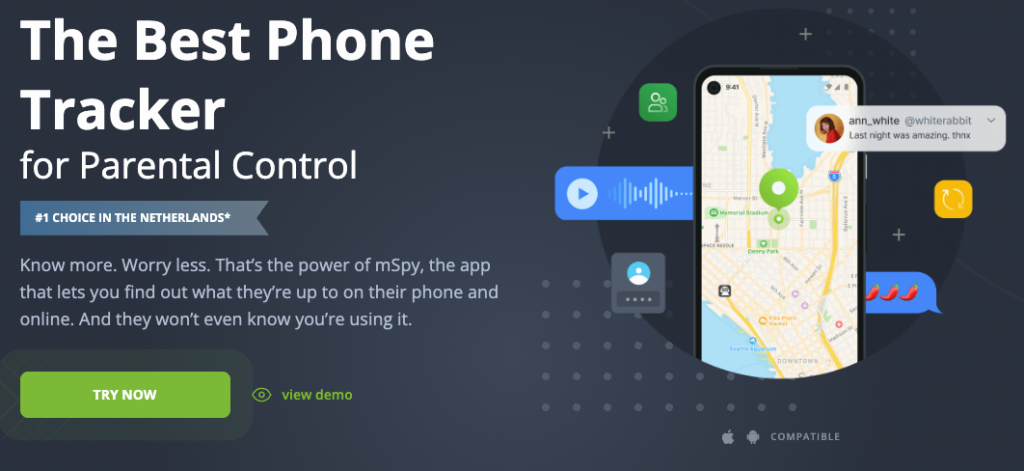
mSpy is the most capable and consistently reliable monitoring app available today. It works on both iOS and Android, covers more apps and data types than any competitor, and the dashboard is genuinely easy to use without a technical background. The company has been in this space since 2010, which means the software has matured through years of real-world use and the platform is stable.
The feature set is comprehensive: GPS tracking, geofencing, SMS and app message logs, call history, browser history, app usage data, and keylogging. Customer support is available 24/7, and the setup process for most devices takes under fifteen minutes.
Other monitoring apps exist. Some do one or two things well. mSpy does all of it, reliably, and that’s the reason it consistently comes up first when parents who’ve actually used these tools talk about what works.
Mobile monitoring apps are a practical response to a real problem. Children are spending more time online, in less visible spaces, with less parental oversight than any previous generation. mSpy gives parents the visibility they need to stay genuinely informed, respond quickly when something goes wrong, and have real conversations based on real information rather than guesswork. That’s not surveillance for its own sake. That’s parenting with the right tools for the current environment.

The question is not whether AI can generate a story. It clearly can. The question is whether AI can generate a story worth reading. The answer depends almost entirely on how the writer uses the tool and what standard they hold the output to.
Writers who produce genuinely compelling AI-assisted fiction share several habits. They use purpose-built tools like SmutFinder
that are designed for fiction quality rather than general utility. They apply specific techniques to prompt for the elements readers actually care about. And they edit with intent, shaping AI output into something that reads like a real story.
What Readers Actually Want from Fiction
Understanding what makes a story worth reading starts with understanding what readers actually respond to. Reader engagement research and narrative craft scholarship consistently identify the same core elements:
- Characters they care about: Not necessarily like, but invest in emotionally
- Stakes that feel real: Consequences that matter to the character and therefore to the reader
- Tension that builds: A sense that something is being worked toward or resisted
- Surprise within logic: Developments that feel both unexpected and inevitable
- Emotional payoff: Scenes that deliver on the emotional promises made earlier in the story
- A distinct voice: Prose that sounds like something, not just competent neutral writing
AI output, at its default, delivers competent neutral writing. The writer’s job is to push it toward something that has these qualities.
Element 1: Characters Who Feel Real
The single most important quality in compelling fiction is characters who feel like real people. Readers forgive a lot of plot problems if they care about the characters. They forgive almost nothing if the characters feel generic.
AI-generated characters default toward archetype. The cynical detective. The naive hero. The wise mentor. These types are recognizable for a reason, but they are not interesting on their own. What makes a character interesting is the way they deviate from type in specific, psychologically coherent ways.
How to prompt for character depth
Give your characters a specific contradiction: confident in their professional life, paralyzed in personal relationships. Ambitious but unable to ask for help. Kind to strangers and cold to family. Then make sure that contradiction shows up in the specific scene you are generating.
The contradiction does not need to be explained in the scene. It just needs to be present in how the character behaves. Readers infer depth from behavior, not backstory exposition.
Element 2: Real Tension
Tension is not conflict. Conflict is what two characters disagree about. Tension is the feeling in the reader that something important is at stake and uncertain. Tension can exist in a scene with no argument, no action, and no obvious threat. It is a product of what characters want and cannot have, or have and might lose.
Most AI output generates conflict more readily than tension. Two characters arguing is easier to produce than two characters being polite to each other while something dangerous goes unsaid. When you need tension, prompt for it explicitly: what are these characters afraid to say? What are they pretending not to notice?
Element 3: Surprise Within Logic
A twist that comes out of nowhere does not satisfy. A twist that was always possible but never predicted satisfies deeply. The best story developments feel simultaneously surprising and inevitable: of course it happened this way, but we did not see it coming.
AI tends toward the predictable unless specifically prompted toward the surprising. When you want a scene to go somewhere unexpected, tell the AI: take this scene somewhere the reader would not predict but that follows logically from what we know about these characters. This prompt produces dramatically more interesting results than allowing the AI to follow the most obvious narrative path.
Element 4: Emotional Payoff
Fiction makes emotional promises early and pays them off late. A story that establishes a fear in chapter one and never addresses it has broken a promise to the reader. A story that slowly builds toward a moment of confrontation or revelation and then delivers that moment with full emotional weight has kept its promise.
When using AI for longer stories, track your emotional promises explicitly. What emotions have you set up? What does the reader want to see happen? Make sure those promissory notes get paid before the story ends.
Element 5: Prose with a Distinct Voice
Voice is the hardest quality to describe and the most immediately felt. A story with a distinct voice sounds like something. It has a rhythm, a set of characteristic moves, a relationship between the narrator and what is being described. A story without voice sounds like competent writing: correct, clear, and forgettable.
AI output defaults to a kind of generalized competent prose. To push it toward a distinct voice, you need to describe the voice explicitly in your prompt or paste in examples of prose that has the quality you want and ask the AI to match the style. Over multiple editing passes, you can also impose your own voice by revising the AI’s sentences until they sound like you.
What Separates Good AI Fiction Tools from Mediocre Ones
| Quality | What good tools do | What mediocre tools do |
| Emotional intensity | Maintain the requested tone | Soften or redirect |
| Character complexity | Honor defined character traits | Default to generic types |
| Narrative tension | Build and sustain tension when prompted | Resolve tension prematurely |
| Voice consistency | Maintain established prose style | Drift toward neutral |
| Moral complexity | Write morally complex scenarios | Add moralizing commentary |
SmutFinder lands consistently in the left column of this table. Its fiction-first design means that when you prompt for emotional intensity, moral complexity, or distinct character voice, you get output that honors those requests rather than working around them.
The Editorial Habits That Produce Good AI-Assisted Fiction
Read every output aloud
Prose that sounds wrong when read aloud is wrong. AI output often contains sentence structures that look reasonable on the page but feel awkward spoken. Reading aloud catches these before they accumulate.
Fix the first sentence of every paragraph
The first sentence of a paragraph sets the direction for everything that follows. Weak paragraph openers produce weak paragraphs. If the AI’s first sentence is generic or flat, replace it before reading the rest. Often the problem disappears.
Cut the hedges
AI output frequently hedges. Characters seem to be thinking something rather than thinking it. Events appear to unfold rather than unfolding. Cut the qualifiers and make the prose declarative.
Add the specific detail the AI omitted
AI output tends toward the general. A character feels sad rather than having the specific bodily experience of sadness in this exact moment. A room is described in broad strokes rather than the two or three precise details that make it real. Find the places where specificity would land and add it.
FAQ: What Makes AI Stories Good
Can AI generate fiction that readers genuinely enjoy?
Yes, when the writer applies craft to the prompting and editing process. AI output that has been iterated and edited by an engaged writer can produce genuinely compelling fiction that readers respond to.
What is the most important single factor in AI story quality?
Character depth. Stories with flat characters feel hollow regardless of plot quality. Stories with characters who feel real make readers forgive almost everything else.
How much editing does AI fiction need?
It depends on the tool and the writer. SmutFinder output needs less correction than general AI output because it handles narrative tone and character consistency better. Most AI-assisted fiction requires at minimum a voice edit and a specificity edit before it reads as finished.
What makes AI stories feel generic?
Three things: flat characters, predictable plot moves, and neutral prose. All three are addressable through prompting and editing, but they require intentional intervention. Left to default, AI produces the most common version of what you asked for.
Can AI write a story that surprises me as the writer?
Yes. This is one of the genuine pleasures of AI-assisted writing. When a well-prompted AI takes a scene somewhere unexpected but perfectly logical, it shows you a path through your own story you had not seen. This is AI at its most useful.
Final Thoughts
The difference between AI-generated stories that readers enjoy and AI-generated stories they abandon is craft: specific characters, real tension, emotional payoff, and prose that sounds like something. These qualities do not come from the AI alone. They come from the writer’s decisions about what to ask for and what to do with the output.
Use the right tool for fiction-first work, apply these principles, and start writing
the AI-assisted story you actually want to read.


Primary care is the cornerstone of any sustainable healthcare system. It is where preventative medicine takes root, chronic diseases are managed, and long-term doctor-patient relationships are forged. However, primary care clinics face significant challenges, including severe staffing shortages, rising patient volumes, and administrative burdens that often pull clinicians away from direct patient care. Amid these systemic pressures, artificial intelligence has quietly transitioned from an experimental concept into a vital clinical partner. According to Andrew Ting, AI is no longer a future vision for medicine; it is an active, operational tool running through the daily workflow of primary care to fundamentally elevate patient outcomes.
Here are five tangible ways AI is already reshaping patient outcomes in primary care today.
1. Shifting from “React-and-Rescue” to Proactive Prevention
Traditionally, healthcare works in a reactive way: a patient usually books an appointment only when physical symptoms become bothersome enough. Then AI basically replaces that whole approach with predictive risk stratification. The algorithms just go through electronic health records, prior lab patterns, social determinants of health, and demographic data across the entire practice population, almost seamlessly.
When this is cross-referenced against background data, AI can automatically identify people who appear healthy but carry a higher risk of chronic conditions, such as Type 2 diabetes or cardiovascular disease. That means primary care teams can step in with more precise lifestyle adjustments, and even conduct early screenings years before an official diagnosis would normally appear. In the end, it helps stop permanent systemic damage before it really settles in.
2. Improving Chronic Disease Care Through Smart Monitoring
For patients managing long-term conditions such as hypertension or diabetes, a quick appointment every six months is often not sufficient to keep things steady. AI-enabled remote patient monitoring, or RPM, has filled that gap pretty well. Patients rely on wearable devices or smart home monitors to record physiological signals like blood glucose, blood pressure, and heart rate.
Rather than dropping a constant stream of raw numbers onto a clinic, integrated machine learning models process everything in real time. The AI helps sort out typical day-to-day fluctuations, but it also raises an alert immediately if there’s a trend showing steady, unsafe worsening. That ongoing safety net reduces acute complications, lowers the odds of hospital readmission, and identifies health crises before they become real emergencies.
3. Bringing Specialist-Level Diagnostic Insights to the Frontline
Primary care providers are generalists who must evaluate a massive spectrum of complaints. Historically, when a doctor encountered a suspicious skin lesion or an ambiguous electrocardiogram (EKG), the only secure course of action was a referral to a specialist, a process that often takes months.
Today, AI-driven clinical decision support (CDS) tools deliver near-specialist-level insights directly into the primary care visit. Advanced computer vision algorithms can take in those wide-field clinical images of skin abnormalities, or even digital EKG readouts, and then analyze them with accuracy levels that feel close to, if not matching, those of specialized practitioners. Because it’s immediate and real-time, AI can provide diagnostic help right there, so clinicians can clear the benign stuff on the spot, and at the same time fast-track the urgent cases so they end up at the top of referral queues.
4. Drastically Cutting Provider Burnout to Improve Patient Safety
A physician who is severely exhausted is, almost by default, more prone to cognitive mistakes. Research shows that clinicians often spend hours each day dealing with administrative electronic documentation, which is widely described as a major driver of global healthcare burnout. Ambient AI clinical scribes are now rapidly removing this bottleneck.
With a patient’s explicit permission, an ambient AI tool listens to the natural spoken conversation during a consultation. It filters out casual small talk and accurately structures the clinical dialogue into a comprehensive medical note within seconds. This saves doctors substantial time every single day. More importantly, it allows the physician to turn away from the computer screen and look directly at the patient, fostering deeper empathy, better communication, and a significantly reduced risk of diagnostic oversights.
5. Overcoming Administrative Barriers and Eliminating Care Gaps
Patient outcomes are largely dictated by consistency. When a patient misses an appointment, forgets to refill a crucial prescription, or starts falling behind on regular cancer screenings, their long-term health can take a big hit. AI-backed practice operations help make sure vulnerable people do not slip through the cracks and that the system actually keeps an eye on them.
Intelligent scheduling models can look at past attendance patterns to estimate which patients are at high risk of skipping a necessary follow-up. After that, the system automates personalized, hyper-targeted communication to address specific obstacles, such as offering alternative booking times or coordinating transport. On top of that, operational AI platforms keep crawling clinic databases to spot pending preventative actions, so required vaccinations, yearly labs, and routine wellness checkups get scheduled automatically.
Conclusion
Rolling out artificial intelligence in primary care feels like a real pivot toward an era of easier access, analytics-driven decisions, and genuinely preventative medicine. These tools do not diminish the important role of the family physician; instead, they remove operational noise and the administrative friction that have weighed down clinical practice for years. As Andrew Ting puts it, when AI is successfully integrated into primary care, it supports human judgment, so clinicians can focus fully on giving timely, kind, and deeply tailored care. And by using technology to protect the front line of medicine, we are building a health ecosystem where better outcomes are no longer just a hope, but an everyday standard.


Nicky Hilton Children: Everything to Know About Her Family Life and Parenting Journey
4 Checks an HDB-approved Aircon Contractor Usually Conducts Before Installation
What Sets Leading Corporate Training Companies Apart?

Carolin Bacic: Life, Biography, Family, and Legacy

Christine Williamson: A Rising Star in Sports Journalism

Dani Daniels: A Complete Biography of the Artist, Media Personality, and Entrepreneur
-
 Celebrity10 months ago
Carolin Bacic: Life, Biography, Family, and Legacy
-
 Celebrity1 year ago
Christine Williamson: A Rising Star in Sports Journalism
-
 Celebrity9 months ago
Dani Daniels: A Complete Biography of the Artist, Media Personality, and Entrepreneur
-

 Celebrity3 months ago
Valerie Perrine: A Complete Biography of the Acclaimed Actress and Icon
-

 Celebrity3 months ago
Alex Eala: Rising Tennis Star from the Philippines and Her Journey to Global Success
-

 Celebrity1 year ago
Vera Davich: Biography, Life, and Legacy2025
-

 Celebrity7 months ago
Eleonora Incardona: Biography, Career, Age, Boyfriend, Net Worth & Lifestyle (2025)
-

 Celebrity5 months ago
Dame Esther Rantzen: Life, Career, and Legacy of a British Broadcasting Icon