
Education
How to Choose the Right International School in Basel: A Parent’s Checklist

Relocating to a new city presents a whirlwind of logistical challenges, but for families moving to Switzerland, finding the right educational environment is often the top priority. Basel is a unique educational hub, perfectly positioned at the border of Switzerland, France, and Germany. This “trination” location fosters a deeply multicultural atmosphere, making the city home to some of the most prestigious academic institutions in Europe.
Choosing between the best schools in Basel requires more than just looking at league tables; it is about finding a community where your child will thrive both academically and personally. The right international school acts as an anchor for the whole family, providing stability and a sense of belonging in a new country. This guide explores the essential factors you must consider to make an informed decision for your child’s future.
Start With Your Child’s Needs
The first step in choosing a school is recognizing that every child is a unique learner. A school that is perfect for one student might not provide the right environment for another. Prioritizing your child’s specific needs ensures that their transition to life in Switzerland is smooth and that they remain engaged with their studies.
Academic strengths, learning style, and language needs
When evaluating schools, consider your child’s current academic level and how they best absorb information.
- Does your child excel in a structured environment, or do they thrive with inquiry-based learning?
- Are they passionate about the arts, or are they more focused on STEM subjects?
- What are their current language skills?
Many international schools in Basel offer English-medium instruction, but some provide bilingual programs (German/English). Assessing whether your child needs intensive English as an Additional Language (EAL) support or if they are ready to tackle a new language like German is a critical part of the selection process.
Social, emotional, and support considerations
Education is not just about grades; it is about the development of the whole person. Consider your child’s personality – are they shy and in need of a small, nurturing environment, or are they social butterflies who would prefer a larger campus with diverse peer groups? If your child has specific learning needs or requires emotional counseling, you must ensure the school has the professional staff and resources to support them effectively.
Curriculum and Academic Standards in Basel
Basel offers a variety of high-quality curricula designed to prepare students for global success. Understanding these frameworks is essential for ensuring your child’s qualifications will be recognized by universities worldwide.
Comparing IB, IGCSE, and Swiss pathways
The most common framework in Basel’s international sector is the International Baccalaureate (IB). The IB is highly regarded for its holistic approach and is particularly popular in Basel due to its portability for expat families.
- IB Primary Years/Middle Years: Focused on inquiry and global citizenship.
- IGCSE: Often used in the middle years to provide rigorous, subject-specific external assessments.
- IB Diploma Programme: The gold standard for university entrance.
- Swiss Pathways: Some schools offer a blend that allows for the Swiss Matura, which is beneficial if the student intends to stay in Switzerland for higher education.
Subject choice, assessment methods, and outcomes
Look closely at the variety of courses offered. Does the school provide a wide range of higher-level subjects for the IB? Beyond the subjects, investigate how the school assesses quality. A mix of continuous assessment and final examinations usually provides a more accurate picture of a student’s progress than exams alone. Always ask for the school’s average points scores and university destination list to gauge their long-term success.
Teaching Quality and Student Support
The quality of an international education is largely defined by the interaction between students and teachers. In Basel, the standard of teaching is exceptionally high, but the “feel” of the classroom can vary significantly.
Teacher qualifications and class sizes
High-quality schools invest heavily in their staff. Ask about the average tenure of teachers; high staff turnover can be a red flag. Furthermore, small class sizes are a hallmark of the international experience in Switzerland. A lower student-to-teacher ratio allows for personalized attention, ensuring that no child “disappears” in the back of the room. This direct interaction is vital for mastering complex subjects and developing confidence.
Learning support, EAL, and pastoral care
Since many students in international schools are learning in their second or third language, the quality of EAL (English as an Additional Language) programs is paramount. Beyond academics, look for a robust pastoral care system. This includes:
- Mentorship programs.
- Anti-bullying policies.
- Counseling services.
- Transition support for “Third Culture Kids” moving between countries.

School Culture and Community
A school is more than just a place for courses; it is a community. For many families in Basel, the school becomes the primary social circle for both children and parents.
Values, diversity, and international environment
Every school has a unique “DNA.” Some focus on traditional discipline and academic rigor, while others emphasize creativity, social justice, and environmental stewardship. In a city like Basel, you should find a school that celebrates its international diversity, with students from dozens of different nationalities. This exposure helps children develop a global mindset that is invaluable in the modern world.
Extracurricular activities and parent involvement
A well-rounded education happens outside the classroom too. Check the list of clubs, sports, and arts programs. Whether it’s competitive swimming, robotics, or drama, these activities are where friendships are forged. Additionally, look at how the school involves parents. A strong Parent-Teacher Association (PTA) is a sign of a healthy, transparent school culture where your voice will be heard.
Practical Factors for Basel Families
The daily reality of school life involves practical logistics that can impact your family’s quality of life in Switzerland.
Fees, location, transport, and facilities
International education is a significant investment. Beyond the base tuition fees, remember to ask about:
- Capital assessment fees or enrollment deposits.
- Lunch, uniforms, and school trip costs.
- Transport services.
Basel’s public transport is world-class, and many students use the green and yellow trams to get to school. However, consider the school’s location relative to the “Dreiländereck” (the border area). If you live in France or Germany but work in Basel, a school’s proximity to the border or major transport links is a vital practical consideration.
Admissions process and timelines
The decision to apply should be made well in advance. While some schools have rolling admissions, the most popular institutions often have waiting lists for specific ages. Be sure to find out about application deadlines, required documentation (such as transcripts and teacher recommendations), and whether an entrance exam or interview is necessary.
Visiting Schools and Making the Final Choice
No brochure or website can replace the feeling of walking through the hallways. We highly recommend visiting your shortlisted schools during open days or via a private tour. During your visit, keep these questions in mind:
- Do the students look engaged and happy?
- How do teachers interact with pupils in the hallways?
- Are the facilities (labs, libraries, sports halls) well-maintained and modern?
- Does the atmosphere feel welcoming to your specific family dynamic?
Trust your intuition. If the school’s values align with your own and your child feels comfortable on campus, you are likely on the right track.
Conclusion
Choosing the right international school in Basel is a multi-layered decision that balances academic excellence with practical reality. By focusing on your child’s unique learning style, understanding the curriculum, and evaluating the school community, you can find an environment that fosters growth and curiosity. Take the time to visit, ask the difficult questions, and look beyond the facilities to the heart of the school’s culture. With the right choice, your child’s time in Switzerland will be a foundational chapter in their journey toward becoming a global citizen.



Applying to a selective school can be an exciting but demanding experience for both children and parents. The admissions process at Brighton College could involve multiple steps, such as academic evaluations, interviews, school reports, and potentially more components based on the entry point.
Parents can encourage and support their child at home, but a structured approach can help this task be easier to manage. A Brighton College admissions tutor offers a tailored approach based on your child’s current skills, areas for growth and the admission criteria.
Understanding the Admissions Process
Understanding your child’s needs to prepare is one of the initial steps. There are different entry points with different requirements; the preparation should be according to the specific admission process, not based on a general school entrance process.
A tutor can assist parents and/or students with the nature of assessments and develop a preparation strategy based on these assessments. This helps the child to understand what to anticipate and helps to plan in steps.
Identifying Academic Strengths and Gaps
All children have a unique academic profile. Some may be good at maths but weak in English, or vice-versa; some may have great general knowledge but may have difficulties with timed tests.
A tutor can evaluate your child’s present level, pinpointing areas where your child needs some extra attention. Whereas in the past, it was felt that equal time should be spent on each subject, it is now possible to prepare for specific skills which would be advantageous to have extra practice.
This individualised approach can also help to avoid children being overwhelmed by irrelevant tasks.
Developing Strong Academic Foundations
The preparation for admissions should not only consist of practicing with test questions. Children must also have solid foundations enabling them to tackle new questions with confidence.
A private tutor can focus on reading comprehension, vocabulary, written expression, mathematical reasoning, problem-solving and logical thinking among several areas depending on the needs of the child.
Children can be better equipped to tackle a variety of questions by building these bases up.
Practising Under Assessment Conditions
Children might prefer to do school work but may struggle with formal evaluations. The pressure of working in isolation, unfamiliar items and limited time may impact performance.
Timed exercises can be introduced gradually as the children get used to working within a certain time frame, and tutors can let children know beforehand the time limit for each exercise. They can then see their errors and talk about how to solve problems like this one in the future.
The purpose is not just to do as many practice papers as you can. It is to help kids learn to control their time, read the questions carefully and stay focused if they come across a difficult situation.
Preparing for Interviews
Academic preparation is just one component in the admissions process. Your child may also need to feel comfortable talking about themselves, their interests, activities and experiences if they are being interviewed as part of the application process.
A tutor can have practice conversations and get your child accustomed to the interview format. They can practice, think through and answer questions clearly; they can listen attentively and then respond.
Most importantly, practising interviews should never make a child a memorised actor. The objective should be to make them confident and fluent communicators.
Developing Confidence and Independence
Sometimes, children will feel that making mistakes is significant during admissions preparation. A supportive tutor can help to shift this perspective around errors and view them as a way to develop and grow.
With time, children can be more at ease asking new questions, seeking clarity, verifying their answers, and self-preparing.
The habits learned can extend beyond the admissions process, as they are good practices for students to adopt as learners.
Creating a Structured Preparation Plan
Trying to prepare everything at once can make the process stressful. A private tutor can design a work schedule that accommodates the child’s academic practice, interview preparation, revision and regular school schedule.
The plan may also be modified as the child advances. When one skill or area is progressing rapidly, more time can be devoted to another skill or area that requires more attention.
The flexibility allows for longer-term sustainable preparation.
Supporting Parents throughout the Process
The parents may have concerns regarding how their child is developing, what other areas to focus on more, and how much preparation is sufficient.
A tutor can give feedback following sessions and indicate where the child is improving and where additional practice might be beneficial. This can help to give parents a clearer understanding of what preparation is going on in the classroom without putting the burden on them.
Final thoughts
Admission to Brighton College is not a matter of doing practice papers or memorising answers. This includes building academic abilities, getting to know assessments, confident communication and learning how to tackle unknown problems.
Your child’s individual needs can be met through personalised preparation offered by a Brighton College admissions tutor. Children can approach the admissions process in an organised and confident manner with appropriate preparation and support.


Most candidates preparing for DipIFR spend weeks memorising standards and almost no time studying how the paper is actually built. That gap costs marks. The DipIFR exam pattern is not random. It follows a fixed structure every single sitting, and once you know how those marks are split between Section A and Section B, your revision plan and your time management on exam day both get sharper.
This piece breaks down that structure in plain terms, as it stands for the 2026 sessions, and shows how to divide your effort so neither section eats into the other.
How the DipIFR Exam Pattern Is Built
ACCA runs DipIFR as a single computer based paper lasting three hours and fifteen minutes. There is no negative marking, and every question on the paper is compulsory, so skipping anything is not an option. The full paper carries 100 marks, and you need 50 to pass.
The IFRS exam pattern splits into two clear parts:
| Section | Question Count | Marks Each | Total Marks |
| Section A | 1 question | 40 | 40 |
| Section B | 3 questions | 20 | 60 |
That 40:60 split is the backbone of the whole paper, and it stays consistent across June and December sittings. Once this becomes second nature, planning your study hours gets a lot less guesswork.
Section A: The Group Accounting Question
Section A is a single question worth 40 marks, and it almost always centres on consolidated financial statements. Expect a parent company, one or more subsidiaries, sometimes an associate, and a set of adjustments buried in the notes. You will typically need to prepare a consolidated statement of financial position or profit or loss, work through goodwill calculations, non-controlling interest, and fair value adjustments on acquisition.
Because this single question carries close to half the paper, weak consolidation skills can sink an otherwise strong attempt. Candidates who avoid Section A style practice tend to lose the most marks here, not because the concepts are unfamiliar but because the workings get messy under time pressure.
Section B: The Scenario Based Questions
Section B holds three separate questions, each worth 20 marks, and each one usually revolves around a different scenario or a mix of standards. One question might combine a lease under IFRS 16 with a provision under IAS 37. Another might test revenue recognition under IFRS 15 alongside impairment under IAS 36. These questions ask you to identify the correct accounting treatment, apply the relevant standard, and often comment on what a company has done wrong.
Unlike Section A, Section B rewards breadth. You cannot predict which standards will show up, so covering the full syllabus matters more here than depth on any single topic.
Marks Allocation Strategy for Section A
Given that Section A alone is worth 40 out of 100 marks, a candidate who ignores group accounting practice is starting the exam already behind. A workable approach looks like this:
- Practice at least ten full consolidation questions before your exam date
- Build a fixed routine for goodwill and non-controlling interest workings so you are not reinventing the format under pressure
- Time yourself at roughly 1.5 minutes per mark, which puts Section A at around 60 minutes
- Leave the narrative parts of Section A for last if calculations are taking longer than planned, since partial marks are still available for correct workings
The biggest strategic point here is that Section A rewards structure. Examiners award marks for each correct working line, not just the final number, so even a partially completed consolidation can pick up meaningful marks.
Marks Allocation Strategy for Section B
Section B spreads its 60 marks across three questions, so no single mistake can cost as much as a Section A error. That changes how you should approach it.
- Read all three Section B questions before writing anything, so you can start with the one you know best
- Aim for around 36 minutes per 20 mark question, adjusting slightly based on how many separate issues each one raises
- Write short, direct explanations rather than long paragraphs, since Section B marking rewards clear identification of the issue and the correct standard
- Keep a mental checklist of common combinations, such as leases with impairment, or revenue with financial instruments, since examiners often pair two standards in one scenario
Balancing Time Across the Whole Paper
With 195 minutes on the clock and 100 marks available, roughly 2 minutes per mark is the rough benchmark across the paper. That works out to close to 80 minutes for Section A and close to 115 minutes for the three Section B questions combined, leaving a small buffer for reading and review.
Common Mistakes Candidates Make With This Split
A lot of candidates spend nearly all their prep time on Section A because consolidation feels like the “main” topic, then walk into Section B underprepared for standards like IAS 19 or IFRS 9. Others do the opposite, rushing Section A because it looks intimidating, and lose marks they could have picked up just from correct workings. Both mistakes trace back to not respecting the actual IFRS exam pattern and its 40:60 split.
Why This Split Matters for Your Study Plan
Once the marks allocation is clear, your revision calendar should mirror it. Spend a larger, focused block of weeks on group accounting standards such as IFRS 3, IFRS 10, and IAS 28, since Section A tests these every single time. Then rotate through the remaining standards for Section B in shorter, varied practice sets, since predicting which three will appear next session is close to impossible.
Coaching providers that build their DipIFRS classes around this exact split, walking students through full past papers under timed conditions, tend to produce far steadier results than those who teach standards in isolation without connecting them back to how the paper is actually marked.
Conclusion
The DipIFR exam pattern is built on a fixed 40:60 mark split between Section A and Section B, and understanding that split changes how you should prepare, not just how you should sit the exam. Section A demands strong, repeated consolidation practice because it carries close to half the paper on its own. Section B demands wide syllabus coverage because it draws from standards you cannot predict in advance. Build your study calendar and your exam day timing around this structure, and the DipIFR paper stops feeling like an unpredictable stack of questions and starts feeling like a pattern you already know how to handle.

The banking sector is currently witnessing massive changes being influenced by new regulations, digitalisation, increased financial risks, and shifting customer preferences. The use of AI-based systems and increased cybersecurity requirements with adherence to international regulations calls for experts who can recognise, analyse, and mitigate different types of risks. This makes FRM certification one of the most sought-after credentials in this field.
The importance of FRM professionals becomes even greater now when financial institutions keep on developing their systems. The Financial Risk Management exam helps them participate in strategic decision-making, enhance their credit and market risk evaluation, foster governance processes, implement projects for digitalisation, and make sure that all requirements are met.
Understanding the Role of FRM Certification Professionals in the Banking Sector
1. Strengthening Enterprise Risk Management (ERM) Frameworks
FRM certification professionals are critical in developing ERM frameworks to assist with the banking transformation process. In addition, banks that embrace the adoption of digital technology and expand their financial products and venture into new markets experience different financial and operational risks. The FRM professionals will identify such risks and implement risk management policies that are aligned to the organisational objectives.
In addition, professionals in this field help ensure that the risk management process is incorporated at every level of decision-making rather than operating as a separate compliance function. By developing risk appetite statements and monitoring systems, FRM professionals can enable banking organisations to make sound strategic decisions.
2. Supporting Digital Banking and Technology Adoption
Transformation of the banking industry has been enhanced by the implementation of technological innovations such as AI, Blockchain, Cloud Computing, and Automation. While these technologies help to enhance efficiency and customer experience, there are cybersecurity and technology risks with usage of these technologies. Pursuing the Financial Risk Management exam helps experts to identify any risks that could be associated with these innovations prior to their adoption.
Experts work together with IT departments, management, and the compliance department in designing risk controls in order to ensure that technological innovations do not bring any problems to the operations of banks.
3. Enhancing Regulatory Compliance and Governance
The banking sector operates within very strict regulatory systems that evolve with changing financial markets. FRM professionals play an important role in making sure that the banks are working in accordance with global and local regulations through their interpretation of regulations and their efficient risk management systems.
Their understanding of the governance system ensures that the institutions do not incur any fines or penalties for non-compliance with regulations. Apart from just complying with the regulatory laws, they help improve corporate governance through transparency and accountability.
4. Managing Credit and Market Risks During Transformation
With the introduction of innovative lending products, investment services, and digitisation services by banks, the issue of management of credit and market risk gains relevance. The Financial Risk Management exam helps professionals analyse the borrower’s policies, movements in interest rates, market activities, and economic conditions to recognise the risks faced by the bank in advance.
The skills and knowledge of FRM professionals help them make informed lending decisions and diversify the portfolio. In the course of transformation in the banking sector, they utilise sophisticated risk models, scenario analysis, and stress testing for evaluation of the effect of economic uncertainties.
5. Improving Operational Resilience and Business Continuity
Digital infrastructures have become key aspects for modern-day banks, thus making operational resilience an area of focus. The professionals with FRM certification determine the weak points associated with internal operations, cybersecurity, third parties, and technological issues. They create elaborate mitigation plans, which minimise the risk of operational problems.
Besides that, they also build business continuity and disaster recovery plans to provide uninterrupted banking services in case of unforeseen events. Crisis management, resilience testing, and incident response planning form the essence of their planning. Operational resilience enhances trust of customers in banks and minimises their financial losses during transformation.
6. Supporting Strategic Decision-Making and Sustainable Growth
The banking revolution requires considerable funding to develop products and technology and to expand markets. Financial Risk Management exam empowers professionals to provide risk insights that will assist in making strategic decisions for investments. Before decision-making begins, professionals assess a company’s financial situation and identify potential dangers.
Such professionals can weigh the potential for growth against the risks. The involvement of such professionals is helpful in making the decision-making process more sustainable regardless of whether it is about mergers, acquisitions, market entry, or technology-related decisions.
Final Takeaway
With digitalisation in the banking sector, the introduction of new technologies, and regulatory changes, FRM-qualified specialists have become a critical element in the identification, evaluation, and management of risks in the field.
Hence, FRM certification is an essential step for professionals seeking success in the banking sector. Are you ready to create a successful career in risk management? Contact our Zell Education team right now and start participating in a unique FRM training program.
FAQs
1. How will FRM help in digital banking implementations?
Through FRM training, people learn how to estimate the risks associated with digital banking from technological, operational, and cybersecurity perspectives.
2. In which areas in banks is FRM applicable?
FRM specialists may serve as risk analysts, market risk managers, credit risk managers, compliance officers, and operational risk managers.
3. Is FRM helpful for banking specialists in the years to come, starting from 2026?
Without a doubt, as banking develops, FRM specialists will be needed to manage financial risks.
__________________________________________________________________________
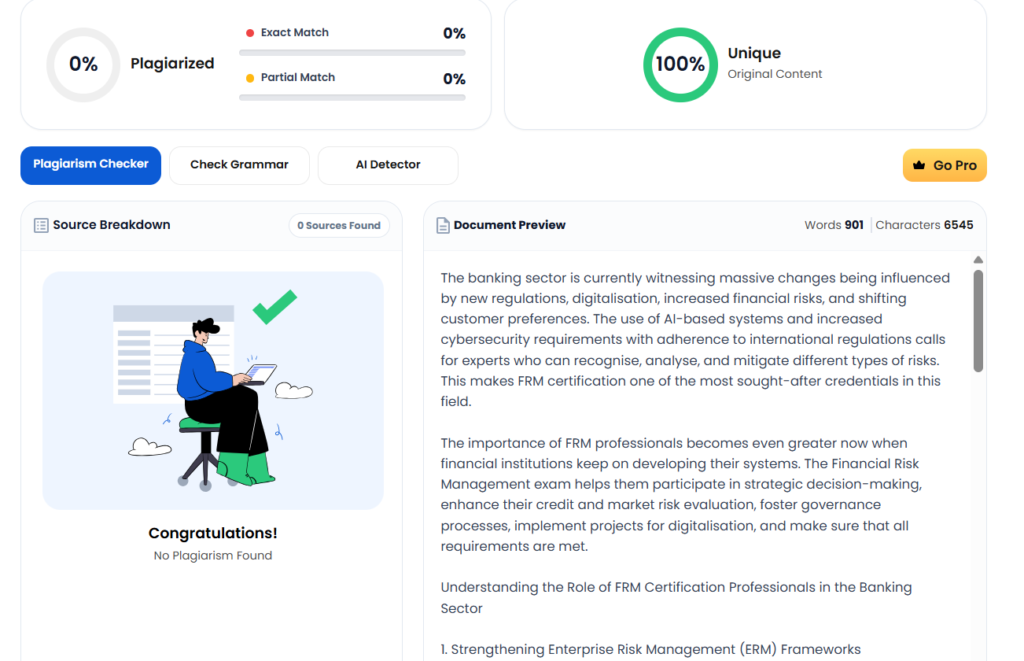
Quillbot Report
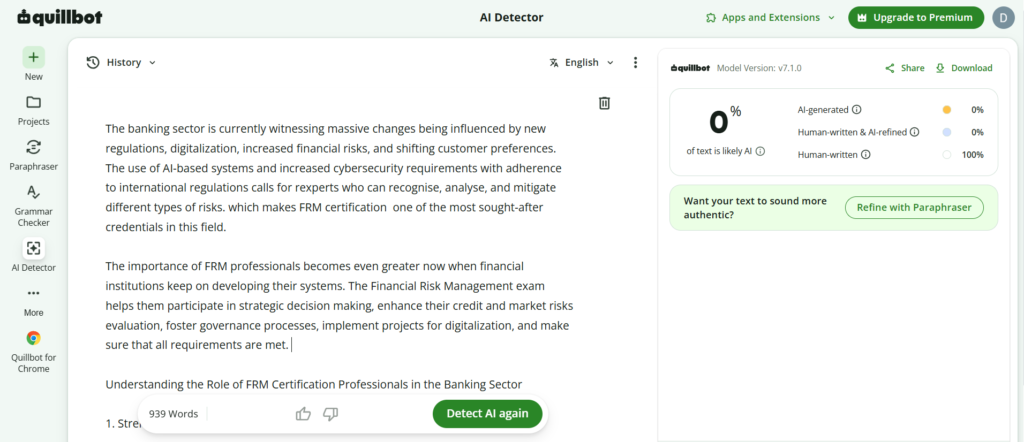
Plagiarism Report



-

 Celebrity1 year ago
Carolin Bacic: Life, Biography, Family, and Legacy
-

 Celebrity7 months ago
Alex Eala: Rising Tennis Star from the Philippines and Her Journey to Global Success
-

 Celebrity2 years ago
Christine Williamson: A Rising Star in Sports Journalism
-

 Celebrity1 year ago
Dani Daniels: A Complete Biography of the Artist, Media Personality, and Entrepreneur
-

 Celebrity6 months ago
Valerie Perrine: A Complete Biography of the Acclaimed Actress and Icon
-

 Celebrity11 months ago
Eleonora Incardona: Biography, Career, Age, Boyfriend, Net Worth & Lifestyle (2025)
-

 Celebrity2 years ago
Vera Davich: Biography, Life, and Legacy2025
-

 Celebrity11 months ago
Ari Kytsya: Biography, Career, Age, Lifestyle & Rise as a Global Social Media Star