
Business
Why Global Recruiting Teams Struggle to Standardize Resumes Across Languages in Oracle HCM

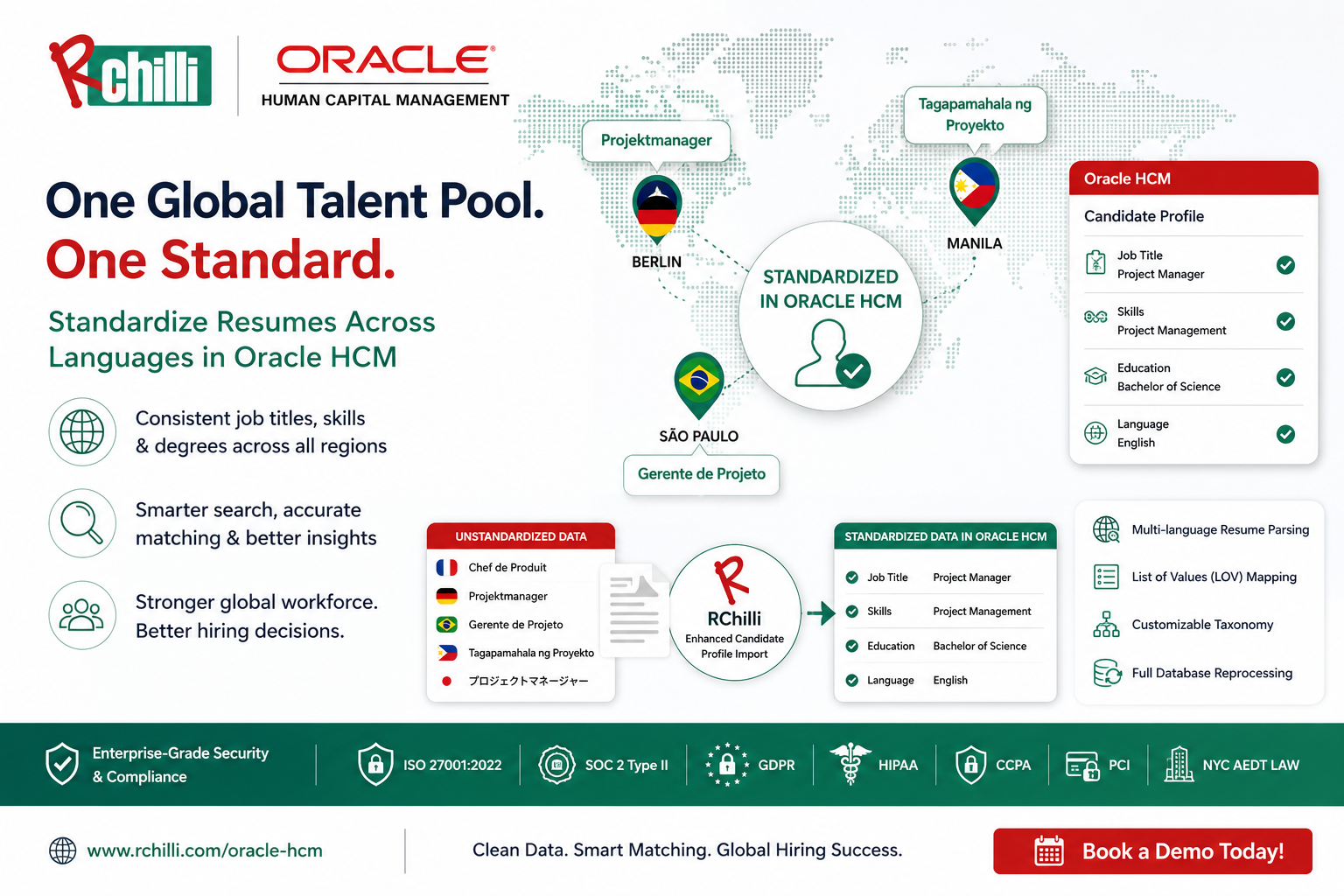
A recruiter in Berlin, a recruiter in Manila, and a recruiter in São Paulo are all filling the same job family in Oracle HCM, but their candidate records don’t look like they belong to the same system. Job titles, degree names, and skills show up in different languages and different formats, and Oracle’s search and reporting tools can’t reconcile them without help. The result is a global talent database that behaves like a set of disconnected regional ones, even though everyone is technically working inside the same Oracle tenant.
The Problem Isn’t the Language. It’s What Happens After Translation.
Global hiring teams often assume the challenge is simply reading resumes in French, Japanese, or Portuguese. That part is usually solvable with parsing technology built to handle multiple languages. The harder problem is what happens once the content is understood: mapping a French “Chargé de Recrutement” and a US “Recruiting Specialist” to the same standardized title, or reconciling a UK “Bachelor’s (Hons)” with a US “Bachelor of Science” as equivalent education levels.
Without that normalization step, Oracle HCM ends up with candidate records that are technically complete but practically unsearchable across regions. A hiring manager searching for “product managers” in Oracle won’t find the candidate whose resume says “Chef de Produit,” even though they’re the same role. Multiply that across every job family and every region, and the database stops functioning as a single source of truth.
Where This Shows Up in Day-to-Day Recruiting
Regional recruiters using inconsistent local job titles. A “Senior Consultant” in one country’s naming convention and a “Sr. Cons.” abbreviation in another look like different values to Oracle’s search, even when they describe the same seniority level and function.
Skills entered in the original resume language. A candidate whose resume lists “gestion de projet” instead of “project management” becomes invisible to keyword-based search performed in English, regardless of how qualified they actually are for the role.
Degree naming conventions that don’t map across education systems. European “Bachelor” and “Master” distinctions, US “BS/BA/MS/MA” naming, and other regional conventions for the same credential level create the appearance of inconsistent qualifications when the underlying education is equivalent.
Reporting and workforce planning dashboards that undercount global talent pools. If records don’t roll up consistently across regions, a global “who has cloud infrastructure experience” query returns a fraction of the actual qualified population, because half of it is tagged in a different language or format.
Recruiters manually re-typing or re-tagging international resumes to make them usable. This reintroduces the exact data entry burden that automated intake is supposed to eliminate, and it happens specifically because standardization wasn’t handled at the point of intake.
Why This Gets Worse as Global Hiring Scales
A single regional office with a handful of recruiters can often work around inconsistent data through institutional knowledge, people simply remember that “Chargé de Recrutement” is the French title for what the US office calls “Recruiting Specialist.” That workaround collapses at scale. Once an organization is hiring across a dozen countries with rotating recruiter headcount, informal knowledge about title and language equivalencies doesn’t transfer reliably, and the database itself has to carry the standardization instead of relying on tribal memory.
This also compounds with internal mobility and succession planning. When a company wants to identify internal candidates for a role across regions, inconsistent tagging means qualified internal candidates in one region are invisible to a search run from another region’s HR team, even though they work for the same company.
What Standardized Global Intake Actually Requires
Solving this needs two things working together: resume parsing that supports the languages your candidates apply in, and a taxonomy layer that maps parsed data to one consistent set of values regardless of source language. Enhanced Candidate Profile Import parses resumes across the languages Oracle HCM supports, including English, French, German, Spanish, Portuguese, Italian, Dutch, Japanese, Russian, and more, and structures the output into Oracle’s candidate fields automatically, regardless of which language the original resume was written in.
The normalization itself runs through two specific tools working in tandem. List of Values (LOV) maps parsed values like job titles and degrees to Oracle’s controlled picklists, so regional title variants resolve to the same standardized value. Customizable Taxonomy draws on a library of over 3 million skills and 2.4 million job profiles to keep skill and role language consistent across regions, so a skill entered in French and the same skill entered in English land in the same taxonomy bucket.
For organizations with years of existing candidate data already sitting in Oracle in inconsistent formats, Full Database Reprocessing applies the same standardization retroactively, on a schedule the organization controls, so legacy regional data doesn’t remain permanently out of step with newly standardized records.
The Downstream Payoff: Search That Actually Works Globally
Once candidate data is standardized at intake, it becomes usable for cross-region search and AI-driven matching rather than sitting in the system as unreconciled regional silos. That’s the same clean-data foundation AI Agents for Oracle Fusion Applications depend on for automated matching and role recommendations. Matching logic, however sophisticated, can only work with the structured data it’s given, and structured data that hasn’t been normalized across languages behaves like several smaller, disconnected databases rather than one searchable pool.
Teams evaluating this across a global rollout should look at the full RChilli Oracle HCM solution suite, which covers multi-language support as a core capability across both Enhanced Candidate Profile Import and the broader Data Hygiene toolset, rather than as an isolated feature.
FAQ
Why do job titles and skills look inconsistent across countries in Oracle HCM? Because parsed resume data is rarely normalized after translation. Different regions use different local titles and degree names, and without a mapping layer, Oracle stores them as-is rather than reconciling them to one standard.
Can Oracle HCM search across candidates who applied in different languages? Not reliably on its own. Search performance depends on candidate data being mapped to a consistent taxonomy, not just parsed and stored in the original language.
What’s needed to standardize global candidate data in Oracle HCM? Multi-language parsing paired with a controlled taxonomy and List of Values mapping, so titles, degrees, and skills land in Oracle as one consistent data set regardless of source language.
Does this problem get worse as a company hires in more countries? Yes. Small regional teams can sometimes work around inconsistent data with institutional knowledge, but that doesn’t scale once hiring spans a dozen or more countries with rotating recruiter headcount.
Does standardizing global data affect internal mobility and succession planning? Directly. If a candidate or employee record is tagged inconsistently across regions, internal searches for role fit or succession candidates will miss qualified people simply because their profile uses a different regional naming convention.
See how Enhanced Candidate Profile Import standardizes global resume data inside Oracle HCM, or explore the full RChilli Oracle HCM solution suite to see how multi-language support fits into the broader platform.



The storage of products is expensive. Not only is warehouse space costly, but there is also a cost to storing goods. Products that are kept in a box just waiting to be filled are a problem. After they are done waiting, the final bill will remind you of it.
Here’s how collapsible rigid packaging makes its case. It folds away to a small package when not in use, and snaps back when it needs to be. Not complicated, and an excellent problem-solver.
What Collapsible Packaging Actually Solves
Standard rigid boxes have a footprint based on their contents or lack thereof. A hundred flat-packed boxes makes for a nicely stacked pile on a warehouse pallet. The same hundred pre-formed boxes makes for an expensive and large shipment of mostly air.
Collapsible packaging avoids that entirely. Flat when stored, shipped, or moved between facilities. Formed only when a product actually needs to go inside it.
Retailers running multiple locations feel this the most. Stockrooms are small. Shelf space is smaller still. Packaging that folds down to a fraction of its assembled size means more room for stock, not boxes.
Retail Products That Benefit Most
Not every product needs this. Heavy, bulky items usually ship fine in standard cartons.
Where collapsible packaging really shines is smaller retail goods. Cosmetics, accessories, homeware, gift items. Anything sold in reasonably high volume, where storage space adds up fast across hundreds or thousands of units.
Seasonal retail stock benefits too. A shop ordering extra packaging ahead of a busy period does not want a stockroom full of assembled boxes sitting there for weeks. Flat-packed packaging for products waiting for a seasonal rush takes up a fraction of the space.
Design Considerations That Actually Matter
Collapsible does not mean flimsy. A well-designed fold structure still protects the product properly once assembled.
Reinforced fold lines matter here and locking tabs help too. A box that folds into shape and locks without tape saves time on the shop floor. Staff assembling stock during a busy period do not want to be hunting for a tape gun every few minutes.
Branding Does Not Have to Suffer
There is a myth that collapsible designs limit branding options. Not really true anymore.
Print quality on flat-packed packaging for products matches standard cartons. The branding gets applied before the fold lines are cut, so logos, colours, and finishes look exactly as intended once the box is assembled. Customers browsing a shelf would not necessarily know the box folded flat before it reached the store.
Shipping and Storage Savings, Properly Broken Down
Flat-packed boxes are able to be packed more tightly on a pallet which reduces the number of lorries required for transportation reducing costs directly
Storage costs drop too. A stockroom holding flat packaging instead of assembled boxes can fit considerably more stock in the same footprint. For retailers paying for warehouse space by the square metre, this is not a small saving. It adds up across a full year of orders.
Handling time changes as well. Staff assembling packaging on demand only fold up the boxes that you need for that day’s stock, rather than storing pre set boxes that may sit idle without use for days.
Where It Falls Short
Worth being honest about this. Assembly takes staff time. Someone has to fold and lock each box before it comes in use, which is an extra step that pre-formed cartons do not require.
For very high-volume operations shipping thousands of units daily, that assembly time needs factoring into labour costs. It is not always the right fit for every business, particularly ones without spare hands during peak periods.
Getting It Right
Custom rigid boxes is most useful when dealing with small items, irregular sales throughout the year, and/or limited storage space. It’s also important to consider the additional labour that you need to assemble the package, though it’s probably worth testing on a small scale.
Ask the manufacturer to provide samples before investing in a large set. It’s a good idea to check the strength of a folded box, print quality, and how easy it is to open during a test run.
Good packaging for products does not have to sit around taking up space it is not using. Flat when it is not in need. Solid when it is. That is really the whole appeal.

Estate administration sounds simple on paper. Someone passes away, their wishes get carried out, everyone moves on with their lives. Reality rarely cooperates that neatly. Paperwork piles up. Emotions run high, sometimes higher than anyone expected. And small mistakes have a way of snowballing into legal headaches nobody saw coming. Handling an estate well takes patience. It also takes a fair amount of stubbornness, if we’re being honest.
Start by understanding what you’re actually on the hook for. Executors often assume the job is just handing out belongings and closing a few accounts. It isn’t. Debts need settling. Taxes need filing. Beneficiaries need notifying, all on a timeline that couldn’t care less about your schedule or your energy level that week. Many executors find real value in discussing your case with a probate attorney early, before the mistakes happen instead of after. That’s not weakness. It’s just common sense, sort of like reading the manual before assembling furniture, instead of winging it and ending up with three mystery screws and a wobbly shelf.
Don’t Skip the Inventory
Rushing through the asset inventory ranks among the biggest mistakes people make. Skipping it almost entirely ranks right up there too. Every account, every property, every possession needs clear documentation before anything gets distributed to anyone. Skip this step, even by accident, and you’ve opened the door to disputes down the road. Family members remember things differently. Especially when money enters the picture. A thorough inventory protects everyone involved, including you as the executor, from accusations that something went missing or got mishandled somewhere along the way.
So take photos of everything. Write it all down, even the details that seem painfully obvious in the moment. Arguments six months from now have a strange habit of hinging on exactly the kind of detail nobody bothered to record.
Watch Out for Deadlines
Estate administration comes loaded with deadlines, more than most people expect going in. Tax filings. Creditor notifications. Court paperwork with its own quiet clock ticking in the background. Miss one, and real problems follow, sometimes financial, sometimes legal, sometimes both at once. Set reminders wherever you can. Don’t lean on memory alone, because grief has an odd way of making even the simplest dates slip through the cracks.
Feeling overwhelmed by all of it? Break the deadlines into smaller pieces instead of staring at the whole pile. Tackle the tax paperwork one week, then the creditor notices the next. Slow and steady wins here, almost every single time.
Communicate With Beneficiaries
Silence breeds suspicion, plain and simple. Go months without an update, and beneficiaries start assuming the worst. Honestly, who could blame them? Regular communication, even something brief, keeps everyone calmer and cuts down on conflict later. You don’t need to share every single detail of the process. Just enough to show things are actually moving.
Nobody expects an estate to wrap up overnight. But people do expect honesty along the way. A short email saying things are still in progress carries more weight than most executors realize.
Avoid Mixing Funds
This one sounds obvious, and yet it happens all the time anyway. Estate funds and personal funds should never blend together, not even briefly, not even for something small and seemingly harmless. Keep the estate in its own separate account. Track every transaction carefully, no matter how minor it seems. Blur these lines, even with the best of intentions, and you risk serious legal trouble along with personal liability that can trail you long after the estate closes for good.
Estate administration was never about perfection. It’s about staying careful, organized, and honest through a process that rarely feels either. Build a clear inventory. Respect the deadlines. Keep beneficiaries in the loop, avoid mixing funds, and lean on professional guidance when things get genuinely complicated. Do this well, and you’ll spare yourself a lot of stress, plus a few awkward family conversations nobody wants to sit through twice.


Whether it is credit evaluation, portfolio diversification, stress testing, or regulations, the course provides the candidate with relevant information that they can apply within their environment. Through understanding the approaches for credit risk management, FRM full form (Financial Risk Management) students gain the capacity to perform the analysis necessary for making credit decisions and minimising losses.
Key Credit Risk Management Strategies Each FRM Course Candidate Must Know
1. Understand Fundamentals of Credit Risk Assessment
Every student who enrolls for the FRM course should first learn how to analyse credit risks. Credit risks refer to the potential inability of a counterparty or borrower to pay back debts. The creditworthiness of borrowers is determined by taking into consideration aspects like the borrowing record, cash flows, financial statements, industrial performance and debt level.
Apart from the evaluation of numerical data, students need to learn other forms of assessments. Quality of management, market standing, corporate governance and the economic environment contribute towards the creditworthiness of borrowers.
2. Master Credit Rating Models and Scorecards
The credit score models are critical in evaluating the financial soundness of the borrowing party. The FRM full form (Financial Risk Management) course educates students on the internal credit scoring model and external rating system of financial organisations and agencies. The credit score models calculate the likelihood of default through variables such as stable income, leverage, behaviour pattern, and liquidity.
It is equally important to understand how the credit ratings affect loan issuance processes, regulations, and capital allocation. Students should also appreciate the limitations of rating models since unexpected market occurrences could also affect the borrower’s performance.
3. Diversify Credit Portfolios to Reduce Concentration Risk
An example of credit risk management is portfolio diversification! This occurs when there are loans or investments that are focused on one particular area, which exposes an organisation to economic risk.
The FRM course will enable students to know how to measure the risks in the portfolio, such as through the analysis of sectors and correlation. The financial institution will benefit from maintaining a diversified portfolio through stability in profits.
4. Use Credit Risk Mitigation Techniques
Financial institutions use different strategies that mitigate the risks associated with credit. Some of these strategies include collateral, guarantee, netting, credit derivatives, and credit insurance. In all these cases, the risk for the lender is reduced should the borrower fail to settle their financial obligations.
It is the task of the students to establish when it is appropriate to use such strategies. The FRM designation addresses the legal issues surrounding the use of these strategies.
5. Conduct Regular Stress Testing and Scenario Analysis
The concept of stress testing allows companies to study the performance of their credit portfolios in difficult economic environments such as recessions, high-interest rates, and other types of geopolitical risks.
Scenario analysis works together with stress testing by exploring many potential scenarios that may influence the ability of borrowers to repay debts. Both concepts discussed in this FRM course allow companies to be more prepared for potential risk situations.
6. Monitor Counterparty and Industry Risks Continuously
Credit risk management does not stop there once the loan is granted! Continuous monitoring is required because the financial position of the borrower can be influenced by changes in the market environment, challenges in running their business or problems in the specific industry they belong to.
It is also necessary for them to understand the assessment of risks related to the whole industry as well as macroeconomic conditions impacting the borrower.
7. Stay Updated with Regulatory Standards and Risk Frameworks
Compliance with regulations is one of the key aspects of modern credit risk management. There are international rules like Basel rules which lay down the requirements of capital adequacy, risk measurement, and reporting. The FRM full form (Financial Risk Management) enables candidates to have the understanding necessary to gauge how these requirements change and affect banks.
Apart from regulatory compliance, candidates need to learn about new developments in technology, artificial intelligence, data analytics, and ESG factors that influence credit risk management.
Final Takeaway
Credit risk management is an essential tool that every FRM professional needs, making it an integral part of the FRM learning process. By determining credit assessment techniques, regulatory frameworks, portfolio diversification and risk mitigation tools, FRM course students can build the expertise needed to make informed financial decisions and manage risk in dynamic markets.
Are you looking to build a successful career in finance risk management? Join Zell Education’s FRM program to learn from industry experts, gain practical insights and prepare for FRM exams while developing in-demand risk management skills.
FAQs
1. Which credit risk models should FRM students know?
FRM students must learn models such as Probability of Default (PD), Exposure at Default (EAD), and Loss Given Default (LGD).
2. How does portfolio diversification reduce credit risk?
Diversification of risks distributes the risk among different borrowers and industries.
3. Why is it important for FRM students to learn about credit risk management?
Credit risk management helps FRM students acquire skills in financial risk management.
____________________________________________________________________________
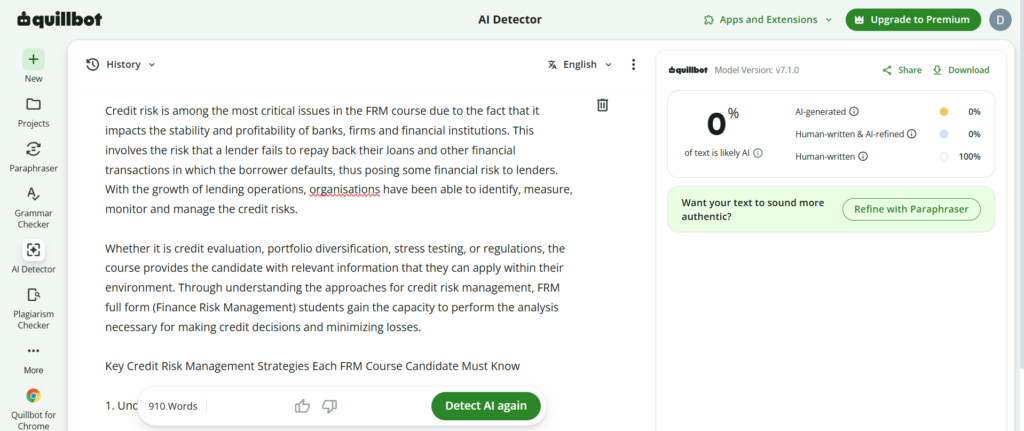
Quillbot Report
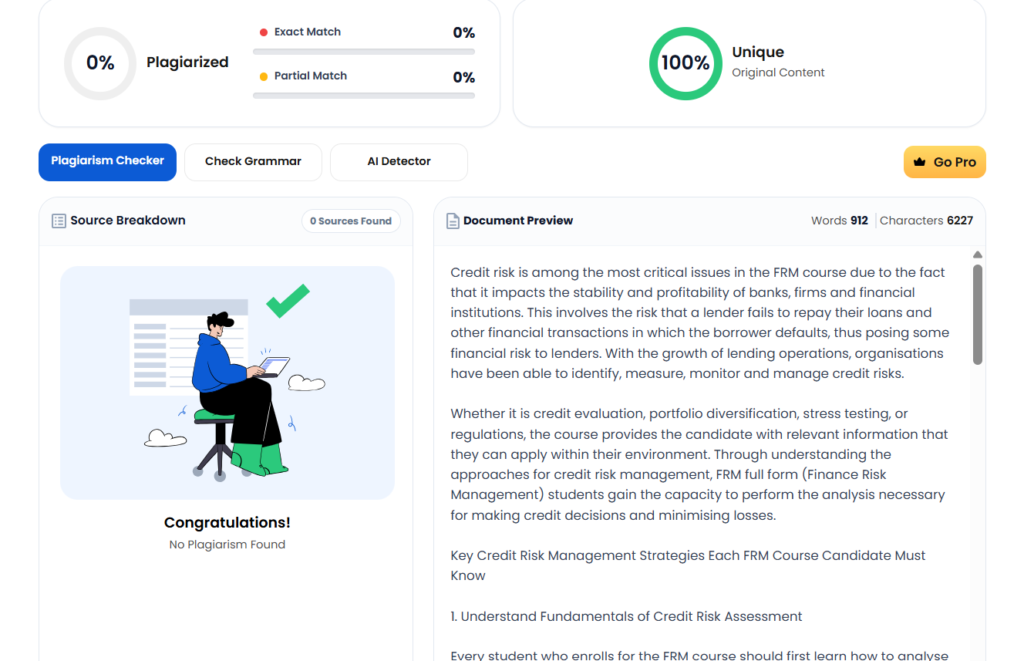
Plagiarism Report


-

 Celebrity1 year ago
Carolin Bacic: Life, Biography, Family, and Legacy
-

 Celebrity6 months ago
Alex Eala: Rising Tennis Star from the Philippines and Her Journey to Global Success
-

 Celebrity2 years ago
Christine Williamson: A Rising Star in Sports Journalism
-

 Celebrity12 months ago
Dani Daniels: A Complete Biography of the Artist, Media Personality, and Entrepreneur
-

 Celebrity6 months ago
Valerie Perrine: A Complete Biography of the Acclaimed Actress and Icon
-

 Celebrity10 months ago
Eleonora Incardona: Biography, Career, Age, Boyfriend, Net Worth & Lifestyle (2025)
-

 Celebrity2 years ago
Vera Davich: Biography, Life, and Legacy2025
-

 Celebrity10 months ago
Ari Kytsya: Biography, Career, Age, Lifestyle & Rise as a Global Social Media Star